



Featured in

















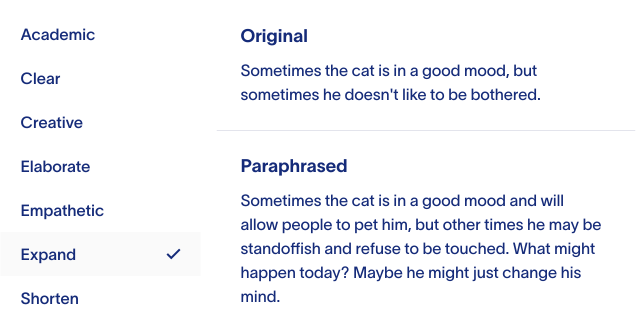
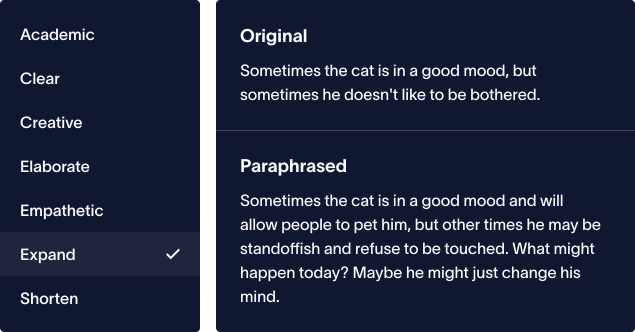
Paraphrase variations in 18 writing modes
Your words and thoughts matter, and we’ve designed our paraphrase tool to ensure find the best words to match your expression. Just paste or start writing your text in our input box above, and our best in class AI will help you to generate the best paraphrases from your original writing.


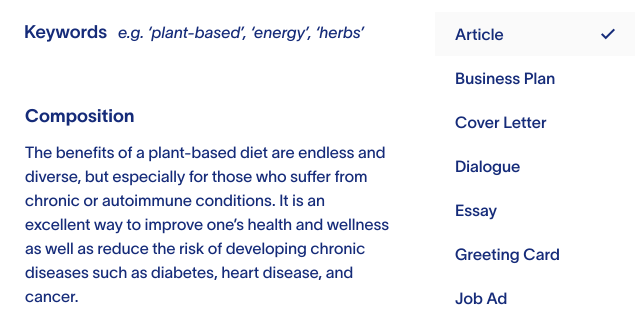
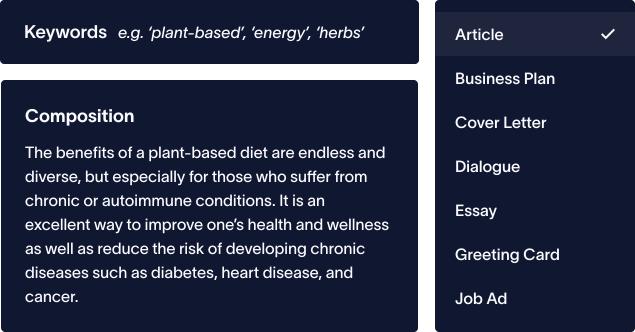
Write 10x faster with keywords in Compose mode
Who has time for writer’s block? Our Composer can help you write 10x faster by enabling you to create paragraphs from keywords instantly for articles, cover letters, essays, and more than 500 other types of writing in 100+ Languages. This way you can focus more on your final work rather than your first draft.


Check plagiarism in 50+ languages
None of us wants to accidentally plagiarize, especially when we spend so much time getting our ideas on paper and refining them. Be sure that your text is unique and 100% FREE of plagiarism by using our plagiarism checker for 50+ languages.
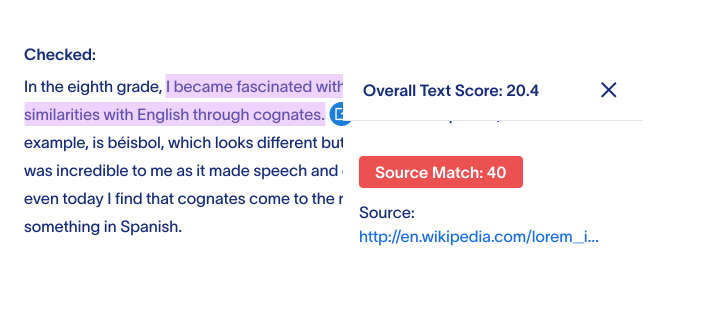
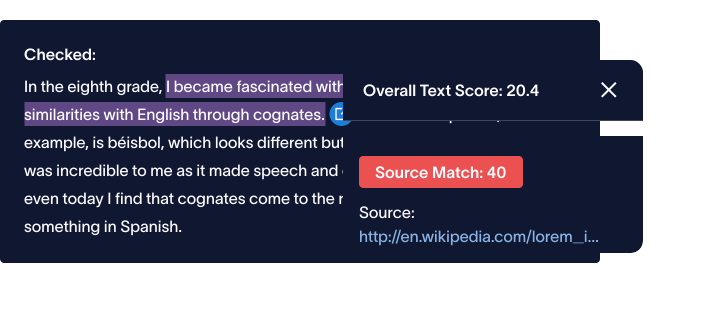


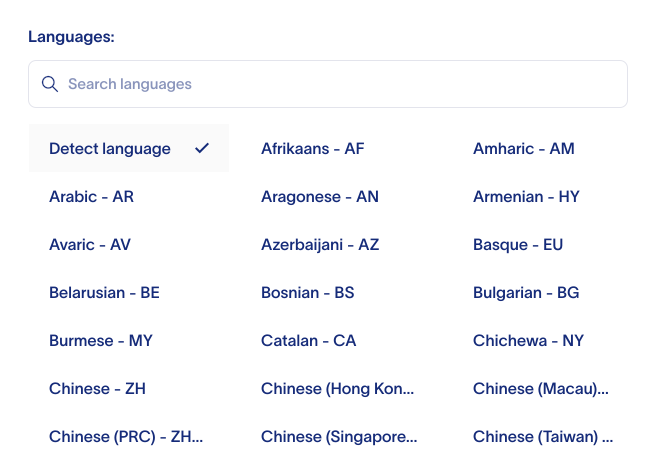
Rephrasely uses state-of-the-art AI to paraphrase and compose in more than 100+ languages
Rephrasely uses state-of-the-art AI to produce variations of your text in more than 100+ languages for each of the eighteen (12 free and 6 premium) styles that we offer. By doing this, we are able to offer more value and variety than any other service.

Unlock your writing
Switch plans or cancel anytime.
All plans include:
Monthly
Billed every month
Annual
$59.88 billed every 12 months
Prepay Credits
What Is Begging the Question?
Begging the question is a logical fallacy in which an argument's premise assumes the truth of the conclusion it is supposed to prove. The reasoning goes in a circle: the conclusion is used as evidence for itself, just phrased differently. This means the argument provides no actual support for its claim.
For example: "This company is the market leader because it outperforms all competitors." The premise ("outperforms all competitors") is just another way of saying "is the market leader." No independent evidence has been offered.
Common Forms of Circular Reasoning
Restating the Conclusion as a Premise
The simplest form of begging the question dresses the conclusion in different words and presents it as proof.
- Circular: "Freedom of speech is important because people should be able to say what they want."
- Improved: "Freedom of speech is important because open debate leads to better policy decisions, as demonstrated by research on democratic governance."
Assuming a Contested Point
Sometimes an argument treats a debatable claim as if it were an established fact, then builds on it.
- Circular: "Since remote work reduces productivity, companies should require in-office attendance."
- Improved: "Several studies from Stanford and Microsoft suggest remote work can reduce collaboration frequency, which may affect productivity in roles that depend on real-time teamwork."
Circular Definitions
Defining a term using itself or using two terms to define each other creates a circular loop that explains nothing.
- Circular: "A good leader is someone who exhibits leadership qualities."
- Improved: "A good leader sets clear goals, communicates expectations, and adjusts strategy based on team feedback."
How to Avoid Begging the Question
Before finalizing an argument, check whether each premise offers independent evidence rather than restating the conclusion. Ask yourself: "If someone didn't already accept my conclusion, would this premise convince them?" If the premise only makes sense to someone who already agrees, it's circular.
Paste your text above to identify arguments that may rely on circular reasoning, with suggestions for strengthening each one with independent evidence.
Related Tools
Try our grammar checker to catch errors automatically, or use the paraphrasing tool to improve sentence clarity.